


I am a Mathematics teacher by trade, so know the power that a culturally valued discipline can have over the education of our young people.
But how it is we desire our students to engage with the disciplines is the important question, which I believe the scholar academic ideology helps us to consider.
Although I don’t specifically write about this ideology too much, it certainly does have incredible amounts of influence in the way that schooling is structured, which Steven Kolber and I wrote about almost three years ago below:
An academic stronghold.

Consider, then, what it means to children when they discover that intellectual (academic) prowess is valued above all. It must hurt to learn early on that one is not quite “up to” the best human beings - Nel Noddings
Go thoughtfully,

Original draft
In this edition I provide a rough outline for the fourth episode of a regular series I currently present on the Teacher’s Education Review (TER) podcast. The series, Ideology in Education, seeks to provide listeners with a brief exploration of the most prominent ideologies impacting on Australian education today. This episode explores the Scholar Academic ideology, its prevalence in Australian education policy and its impact on the teaching profession.
Introduction
Hello TER listeners and welcome to the fourth episode of Ideology in Education. A series providing a snapshot of the most prominent ideologies influencing Australian educational policy and discourse today, and how it impacts on your teaching practice.
In Australia, we have an educational curriculum that is atomised in many ways. In particular we see subjects, such as Arts, Physical Education and Mathematics split into their respectful disciplinary studies, treated traditionally as separate from one another. The disciplines are generally given specific allotments of time in the school day, though occasionally within different schooling environments we may see an interweaving of different disciplines (what we might call ‘cross-curricular’ in the teaching lingo). Oftentimes, we see a revival in educational discourse for curriculum to reflect the core essence of the disciplines. For example, what sort of skills and knowledge do Mathematicians use in their work? How might a Psychologist look at social interactions? What kinds of evidence would a Historian review? This desire to inculcate students into disciplines is a calling card of the Scholar Academic ideology, which we will look into briefly today.
So, what is the Scholar Academic ideology?
The core belief directing the Scholar Academic advocates is that schooling should inculcate individuals into the academic disciplines, which can be understood as independent fields of knowledge that have been proven valuable for our cultural heritage. For example, the enduring value of say Mathematics might be considered important in the way it has contributed to the development of Western civilisation. So within this framework it is important to see each discipline as free-standing, with its own histories, types of knowledge, methods, etc.
Education grounded within this ideology is focused on the dissemination of knowledge, from academics in the discipline, to teachers (who are considered to be seen as mini-scholars) and finally to students. In order for this to happen, the structure follows that academics within each discipline are responsible for developing the official knowledge (or curriculum) deemed important by the discipline. It is therefore the responsibility of teachers to disseminate this knowledge to their students, in a manner that considers their stage of development.
Lastly of note, an important aspect of Scholar Academic ideology is that teachers are not expected to simply provide facts about a discipline, but bring students into the discipline. This means that students are taught to think and act the way an academic within that discipline would do so.
How does this play out in Australian education?
Firstly, in Australia all states have accepted the implementation of the Australian Curriculum (or an adapted version of it in the case of Victoria and Northern Territory) in their public schools. The actual structure of the Australian curriculum is reflective of the Academic Scholar ideology in the way that it is split into learning areas by discipline (i.e. English, Science, etc.). We might also see how certain disciplines include more explicit aims to inculcate students into the discipline, such as with the sciences (for example, the inclusion of ‘science inquiry skills’ in the Australian Curriculum or ‘key science skills’ included within the VCE sciences). However, having an atomised curriculum (such as what we have in Australia) ignores the way in which the boundaries between disciplines might cross and overlap in interesting ways (where the whole justification for cross-curricular studies comes in). Some might argue that disciplinary studies in fact can never be truly separated and that it is disingenuous to foster in students these kinds of dualistic attitudes towards various disciplines of knowledge.
Another parallel to Scholar Academic thinking is the way in which the Curriculum is developed by experts within the relevant disciplines. Now although the specific individuals involved are actually quite difficult to ascertain (it was a painful process trawling through the countless numbers of official government documents to find the information, but I will keep trying!), it is indicated that those involved in writing the Australian curriculum were chosen due to their ‘expertise in the area, the esteem in which they are held in the community, their networks and their deep knowledge of the learning, pedagogy and what works in professional practice’ (ACARA, 2016, p. 12). Unfortunately, it is unclear (at least from what I have found so far!) whether those involved in writing the curriculum for each discipline are in fact academic experts within the field, but we can probably assume this to be the case (please feel free to correct me if I’m wrong!).
Another important aspect of Scholar Academic ideology is the way in which it seeks to discern those who know the discipline ‘best’, in order to ensure the integrity of those continuing the pursuit of knowledge within the specific field. Therefore, standardised measures of assessment through the use of summative exams are welcomed by Scholar Academic ideologues, who see this as the most effective way of determining those fit for continuation within the discipline through higher education. Consider for example, in my state of Victoria, how VCE final exams for various subjects often include questions ranging from simple to very complex, as a means of separating those individuals who possess a surface understanding of a discipline as opposed to those with a deep knowledge of the discipline. Further to this notion of ranking, every state in Australia in some way or another has a form of ranking system in place to determine university entry, based on summative exam results of student’s final year of schooling. It is not too difficult to understand the logic here. For example, universities may only wish to have the most academically suited candidates for continuation in the field of medicine. Therefore, students who perform well on final year exams (presumably reflecting high academic standard) are considered to be well suited to continue in the discipline. This all works together to move students possessing deep knowledge of a discipline into becoming academics in the field.
What does this mean for me as an educator?
Within a Scholar Academic framework, educators are accountable for disseminating new knowledge from the disciplines. In a way, we could see educators as working for the various fields of academic study, such as History or Physics, to develop new Historians and Physicists. So educators work to continue the traditions of each disciplines deemed valuable to society, gathering disciples and recruits for them.
As a teacher you are expected to be well versed in your discipline, defined as a kind of ‘mini-scholar’. You are expected to be the expert in the classroom, carrying on the process of dissemination to your students. This seems a no brainer and the ideal for any teacher of a specific discipline. Now we may desire for teachers to be experts in their fields, but the current educational climate in Australia seems pretty far off from this being a reality. Within schools it is common for teachers to be teaching disciplines out of their fields of expertise, as argued in a recent study on out-of-field teaching in Australian secondary schools (Weldon, 2016). The graphic below gives an indication of how prevalent this is in Australia.
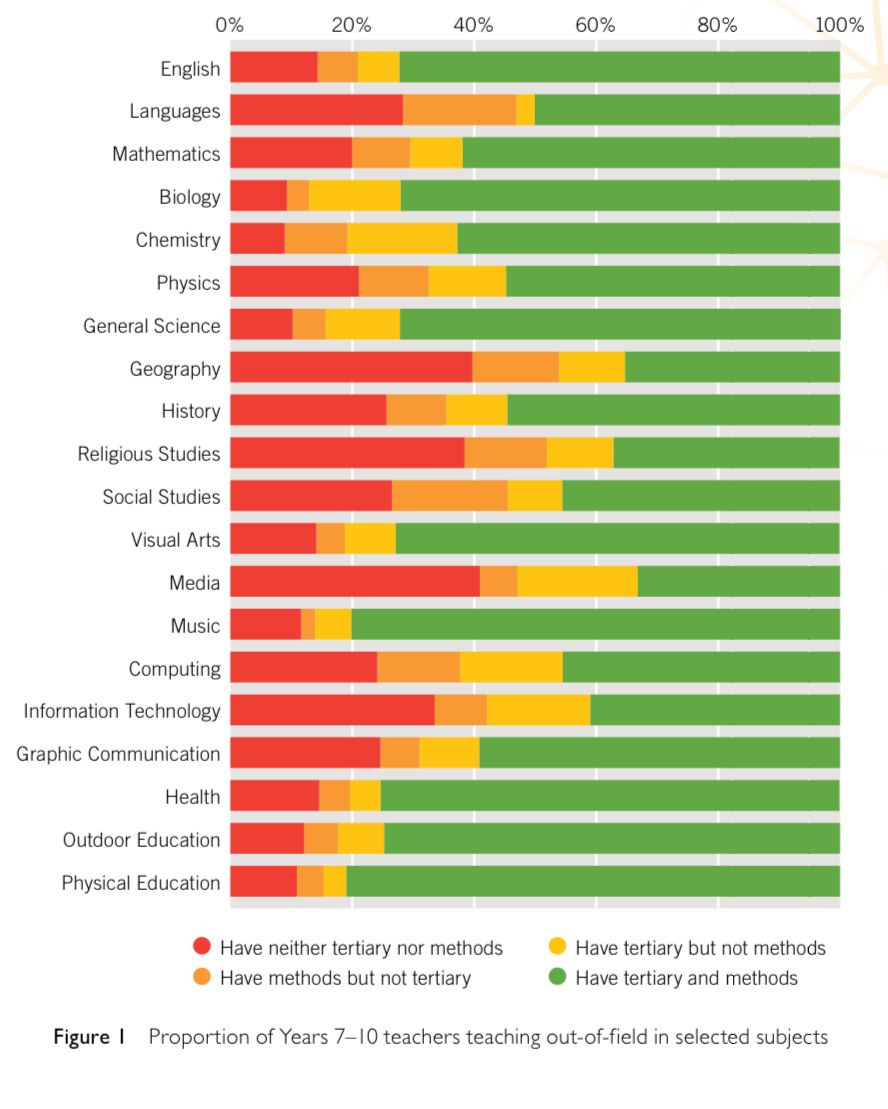
These sorts of findings have contributed to the push for mid-career professionals to enter the teaching profession, as our current minister for education Alan Tudge has been quite vocal about (I provide a brief critical analysis of one of Alan Tudge’s media releases in a previous edition of The Interruption here), as a way of solving this issue.
Now bear in mind, I’m not saying that teachers who are not experts in their field are not good teachers. I believe pedagogy to be far more nuanced than to simplify it in such a way. What I am trying to do is consider the importance of this matter within a Scholar Academic standpoint, as this helps us to understand the logic within the discourse often thrown around about these sorts of things.
The final thing I wanted to share in relation to the role of the teacher here, is how they’re encouraged not simply to disseminate knowledge, but invite students into the disciplines as rookies in the field. For example, in a Scholar Academic classroom students might be given opportunities to observe like psychologists, interview like sociologists and problem solve like mathematicians. There is a real excitement in not just learning about a discipline, but being a part of one as a whole. Like I discussed earlier, there does not seem to be much in the way of explicit approaches involving this kind of inculcation mandated within curriculum in Australia, apart from the sciences (which push very much for science skills). But I’m sure there are plenty of teachers enacting this sort of approach as it just seems to be a helpful tool for engaging students in a variety of subjects.
So, where to from here?
The Scholar Academic ideology has been influential in the development of rigorous, relevant curriculum (in its connection to academics within the disciplines), engaging students in the diverse ways the different disciplines discover knowledge and in encouraging teachers to be proficient in their fields.
However, the promotion of disciplinary knowledge as the fundamental purpose of curriculum, as well as standardised testing measures to discern student proficiency has contributed to many of the accountability and back-to-basics movements over the last forty years. Many of these movements continue to resurface in various forms within educational discourse, despite the lack of results these kinds of policy reforms proclaim to make in education. Not to mention the at times, quite damaging impacts of these reforms on all areas of education.
Furthermore, the push for ‘back-to-basics’ type education by Scholar Academics often involves devaluing (or simply turn a blind eye to) other important types of knowledge within a school environment (such as the Arts, Vocational Training, or general skills such as Food Technology, etc.). The whole question of who decides what disciplines are of most value is also a contentious issue here.
The Scholar Academic ideology also does not concern itself with matters of power or class. Though I’m sure many teachers would appreciate the idea of only concerning themselves with their discipline and disseminating the knowledge of this to their students, it is impossible to disregard the plethora of factors that are present within the schooling environment that deserve a place within curriculum and what is taught in schools.
What I think is quite clear though, is that education in Australia is understood as not simply a servant of the disciplines, but is involved in the shaping of individuals for participation in society and the world.
So here we are, four episodes down. Join me next time as I explore the final ideology for this series, the Social Reconstruction ideology.
Till next time.
References
Australian Curriculum and Assessment Authority. 2016. Curriculum development process v 6.0, retrieved 15 July 2021 https://docs.acara.edu.au/resources/ACARA_Curriculum_Development_Process_Version_6.0_-_04_April_2012_-_FINAL_COPY.pdf.
Weldon, P. R. 2016. Out-of-field teaching in Australian secondary schools, Policy Insights, vol 6.


